




Start typing to see results...
Find the perfect solution
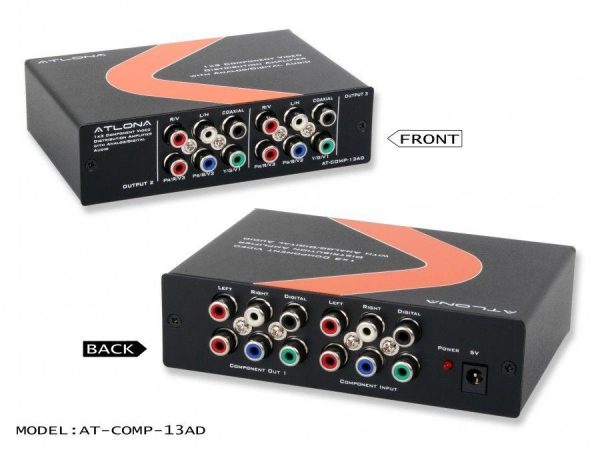
A component video distribution amplifier routes analog component signals (Y, Pb/Cb, Pr/Cr on three RCA or BNC connectors) from one source to multiple displays. Though digital interfaces dominate new installations, component video remains in active use across home theaters, hospitality venues, broadcast monitoring, and any environment where existing HDTVs, projectors, or AV switchers still rely on the format.
Component video separates the signal into a brightness channel (Y) and two color-difference channels (Pb/Pr or Cb/Cr), giving sharper analog video than composite or S-Video. Composite mixes everything onto one wire, S-Video separates luma and chroma but limits to SD, and component supports HD all the way up to 1080p natively, making it the highest-quality analog video format in mainstream consumer and commercial AV.
Modern component distribution amplifiers typically support 1080i and 1080p. This makes component useful in residential AV and projector-based setups alongside more modern HDMI distribution, especially when the source equipment (cable boxes, satellite receivers, legacy DVD players) only outputs analog. Audio is not part of the component signal, but most distribution amplifiers include paired stereo audio inputs and outputs on RCA to keep AV bundles intact.
Component DAs accept a single input and split it to multiple outputs, typically 1x2, 1x4, 1x8, up to 1x32. They can be cascaded for very large output counts without the picture degradation seen in fully passive splitting. Some units also include CAT5 outputs for extending each leg up to 150 feet (45 meters) or more, useful in hospitality and multi-room installations.
Component video is an analog signal, so quality degrades with distance. The practical limit on standard cable is about 50 feet (15 meters) for HD resolutions. For SD content, 100 feet or more is usually acceptable. Beyond these distances, use component-over-CAT5 extenders paired with the distribution amplifier to reach 150 feet (45 meters) or more per leg.
Component distribution amplifiers are common in home theaters, hospitality (hotels, bars, multi-room AV), broadcast monitoring, houses of worship with legacy equipment, and any commercial AV system with installed component infrastructure that has not migrated to HDMI.
Component video is a three-cable analog video format that supports up to 1080p, common in legacy HDTVs and many cable/satellite set-top boxes. It separates the signal into a brightness channel (Y) and two color-difference channels (Pb/Pr or Cb/Cr), giving sharper analog video than composite or S-Video. Even many newer HDTVs still accept component up to 1080p, which is why it remains useful in installations with existing component sources and displays. Component is the highest-quality analog video format in mainstream consumer and commercial AV.
Yes. Component is one of the few analog video formats that supports HD resolutions natively. A quality component distribution amplifier passes 1080i and 1080p signals to all outputs at full quality, assuming the source provides them and cable runs stay within reasonable length. Component handles deep color and high resolutions well because the three channels carry signal information separately, which avoids the color crosstalk problems that limit composite and S-Video to SD resolutions.
The video path does not. Component is video-only, with no provision for audio on the three RCA or BNC connectors. Most distribution amplifiers add separate L/R audio inputs and outputs on RCA jacks, so AV bundles stay intact through the splitter. When buying a component distribution amplifier, check the audio specs: some entry-level units split video only, while commercial units include matched audio channels per input and per output.
Up to about 50 feet (15 meters) for HD on standard cable; longer with quality cable or active extension. As an analog signal, component degrades with distance: at HD resolutions, 50 feet is a practical limit on typical RG-59 or RG-6 cable. For SD content, 100 feet or more is usually acceptable. Beyond these distances, look for component-over-CAT5 extenders that pair with the distribution amplifier, allowing each output leg to reach 150 feet (45 meters) or more. Quality matters: thick, low-loss cable extends the practical limit, and tight connectors prevent intermittent signal issues.
Yes, and active distribution amplifiers cascade well for very large output counts. Component DAs re-amplify the signal on each output, so feeding one 1x8 into a second 1x8 to fan out further introduces minimal additional degradation. In theory, an unlimited number of TVs can be served this way without visible picture loss, though in practice every additional active stage adds slight latency and any electrical noise on the way. Verify that all units support the same maximum resolution (1080p or only 1080i) to avoid silent fallback in the chain.
Home theaters, hospitality (hotels, bars, multi-room AV), broadcast monitoring, houses of worship, and legacy commercial AV are the most common environments. Examples include distributing a DVD player or satellite receiver to multiple TVs in a hotel lobby or bar, feeding the same content to several zones in a residential AV system, driving repeat screens in a worship venue where existing component infrastructure remains in service, or supporting broadcast monitoring chains that have not yet been replaced with HDMI or SDI gear.

On order over $300 and more for US and US territory

We Offer a 30-Day Money Back Guarantee

Full manufacturer's warranty and quality assurance

Safe checkout with trusted payment providers