




Start typing to see results...
Find the perfect solution
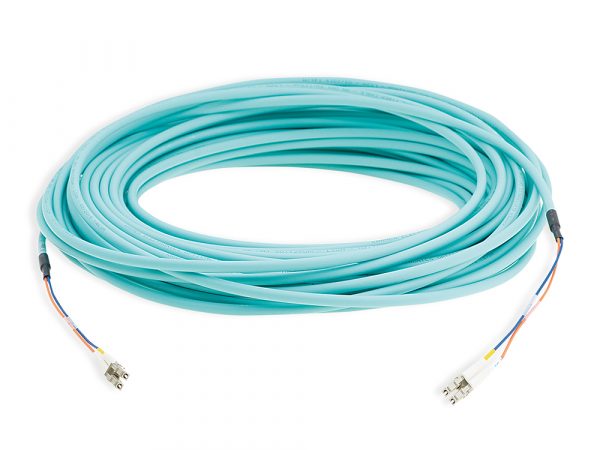
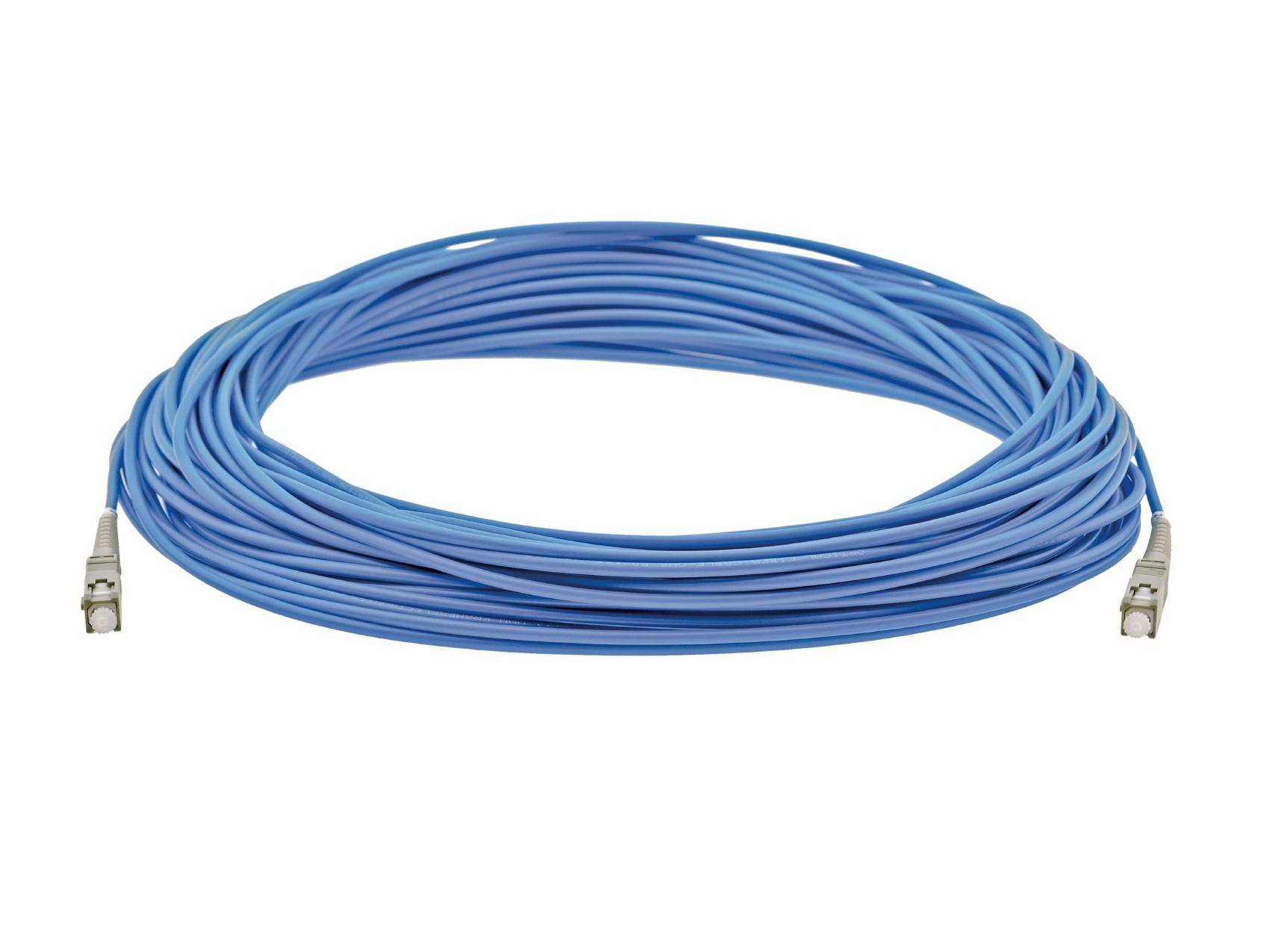
Multimode fiber connection cables carry digital signals as pulses of light through a fiber core that is wide enough (50 or 62.5 microns) to allow multiple modes of light to propagate simultaneously. They are the workhorse fiber type for in-building backbone runs, within-room equipment connections, and any application where the run is under about 500 meters at high data rates. Multimode is the cheaper and easier-to-deploy choice for shorter distances; single-mode fiber takes over for longer runs.
Multimode fiber comes in several categories: OM1 (62.5/125 micron, legacy), OM2 (50/125, also older), OM3 (50/125, laser-optimized for 10 Gbps to 300 meters), OM4 (50/125, improved for 10 Gbps to 400 meters and 40/100 Gbps to 150 meters), and OM5 (50/125, wideband for short-wave WDM up to 100 Gbps in one fiber). OM3 and OM4 dominate modern AV and IT installations. Always match the fiber category to the data rate and distance of the application.
Multimode fiber connectors and patch cables are typically aqua-colored for OM3 and OM4 (sometimes called "laser-optimized multimode" or LOMM), and orange for OM1 and OM2. The color helps installers immediately identify the fiber category and avoid mismatching cables. Multimode transceivers use 850 nm or 1300 nm wavelengths (vs. 1310 and 1550 nm for single-mode), with shorter ranges but lower cost.
Multimode fiber uses the same connector types as single-mode: LC (most common modern), SC (older but still used), ST (legacy), and MTP/MPO (high-density). Most modern multimode installations use LC duplex. Always match the connector at both ends of the cable to the corresponding port on the patch panel, wall plate, or device.
Multimode fiber is essential in AV-over-IP installations where the encoders, decoders, and switches need fiber connectivity but the runs are within a single building. Specific applications include 4K AV-over-IP video walls (multiple sources to many displays on a single fiber backbone), large auditorium and worship spaces (sources to amplifier and projector locations), broadcast and TV studio infrastructure (camera, recorder, and monitor connections), and digital signage installations (one media-server room to dozens of displays via fiber).
Multimode patch cables are constructed with the fiber core in a tight buffer (for indoor cables) or loose tube (for outdoor and long-distance cables), surrounded by Kevlar (aramid) yarn for strength, and an outer jacket. Plenum-rated multimode cable (OFNP) is required for return-air spaces in commercial buildings. Riser-rated cable (OFNR) works for vertical runs between floors. Always specify the right jacket for the installation.
Multimode fiber connection cables are widely used in AV-over-IP networks (most modern AV-over-IP encoders and decoders include fiber options, with multimode being the cost-effective choice for in-building runs), in-building network backbones (between equipment rooms, racks, and floors), data centers and server rooms (server-to-switch and switch-to-switch connections), broadcast and TV facilities (camera and equipment connections within a studio or facility), and any installation where fiber is needed but distances stay under about 500 meters.
The OM (Optical Multimode) categories describe progressively better multimode fiber with improved bandwidth and distance support at high data rates. OM3 supports 10 Gbps to 300 meters and 40 or 100 Gbps to about 100 meters using laser-optimized 50-micron core. OM4 improves the same core type to support 10 Gbps to 400 meters and 40 or 100 Gbps to 150 meters, with lower loss. OM5 adds support for wideband WDM (multiple wavelengths in one fiber), enabling 100 Gbps on a single multimode pair using fewer fibers. OM3 and OM4 dominate modern AV and IT installations; OM5 is appearing in newer data centers and high-density applications.
The maximum distance depends on the fiber category and the data rate. For 1 Gbps, OM3 and OM4 support 600+ meters. For 10 Gbps, OM3 supports 300 meters and OM4 supports 400 meters. For 40 or 100 Gbps, OM3 supports 100 meters and OM4 supports 150 meters. These are the practical maximums; you can always run shorter distances. For longer runs (beyond about 500 meters at high data rates), use single-mode fiber, which supports kilometers with the right transceivers.
Modern multimode fiber and patch cables are color-coded for quick identification. OM3 and OM4 (laser-optimized 50-micron multimode) are typically aqua-colored cable jackets, sometimes called LOMM (Laser-Optimized Multimode). OM5 is lime-green to distinguish it from OM3 and OM4. OM1 and OM2 (older multimode) are typically orange. The color is printed on the cable jacket and on the patch cable boots. When in doubt, check the printed text on the cable jacket, which includes the category designation explicitly (e.g., "OM4 50/125").
Yes, but the link will perform at the rating of the lower category (OM3) for the link length. Mixing categories does not damage anything; it just limits the achievable distance and bandwidth to the lower spec. For example, an OM4 trunk cable with OM3 patch cables on each end performs as an OM3 link overall. For best performance, use the same fiber category throughout the link, especially for high-bandwidth or long-distance applications.
Multimode has a larger core (50 or 62.5 microns) that allows multiple light modes; cheaper transceivers but shorter range (typically under 500 meters at high data rates). Single-mode has a much thinner core (about 9 microns) that allows only one light mode; more expensive transceivers but much longer range (10 km easily, 80+ km with the right gear). For AV runs within a building (typical AV-over-IP installations, in-room and in-building backbones), multimode is the right choice for cost. For runs between buildings, across a campus, or anywhere over about 500 meters, single-mode is essential.
AV-over-IP installations (most modern encoders and decoders include fiber options for backbone and long-run connections; multimode is the cost-effective choice for in-building runs), in-building network backbones (between equipment rooms, racks, and floors), data centers and server rooms (server-to-switch and switch-to-switch connections at 10 Gbps and higher), broadcast and TV facilities (camera, recorder, and monitor connections within a studio or facility), digital signage installations (one media-server room serving dozens of displays via a fiber backbone), and any AV or IT installation where fiber is needed for bandwidth or noise immunity but distances stay under about 500 meters.

On order over $300 and more for US and US territory

We Offer a 30-Day Money Back Guarantee

Full manufacturer's warranty and quality assurance

Safe checkout with trusted payment providers