




Start typing to see results...
Find the perfect solution

RS-232 and IR extenders extend control signals over long distances, letting a control system or remote control operate AV equipment that is too far away for the native signaling to reach. RS-232 is the serial communication standard used to send commands from a control system to AV devices (projectors, displays, AV receivers, switchers). IR (infrared) is the standard for remote control commands between handheld remotes and AV equipment. Both have distance limits that extenders overcome.
Modern commercial AV installations often have the AV equipment in an equipment rack far from where users actually operate the system. The remote control still needs to communicate with the equipment (IR), and the control system processor still needs to send commands to all the devices (RS-232). Without extenders, the user couldn't use a remote control in the conference room because the equipment is in a rack down the hall, and the control processor couldn't reach a projector at the far end of an auditorium.
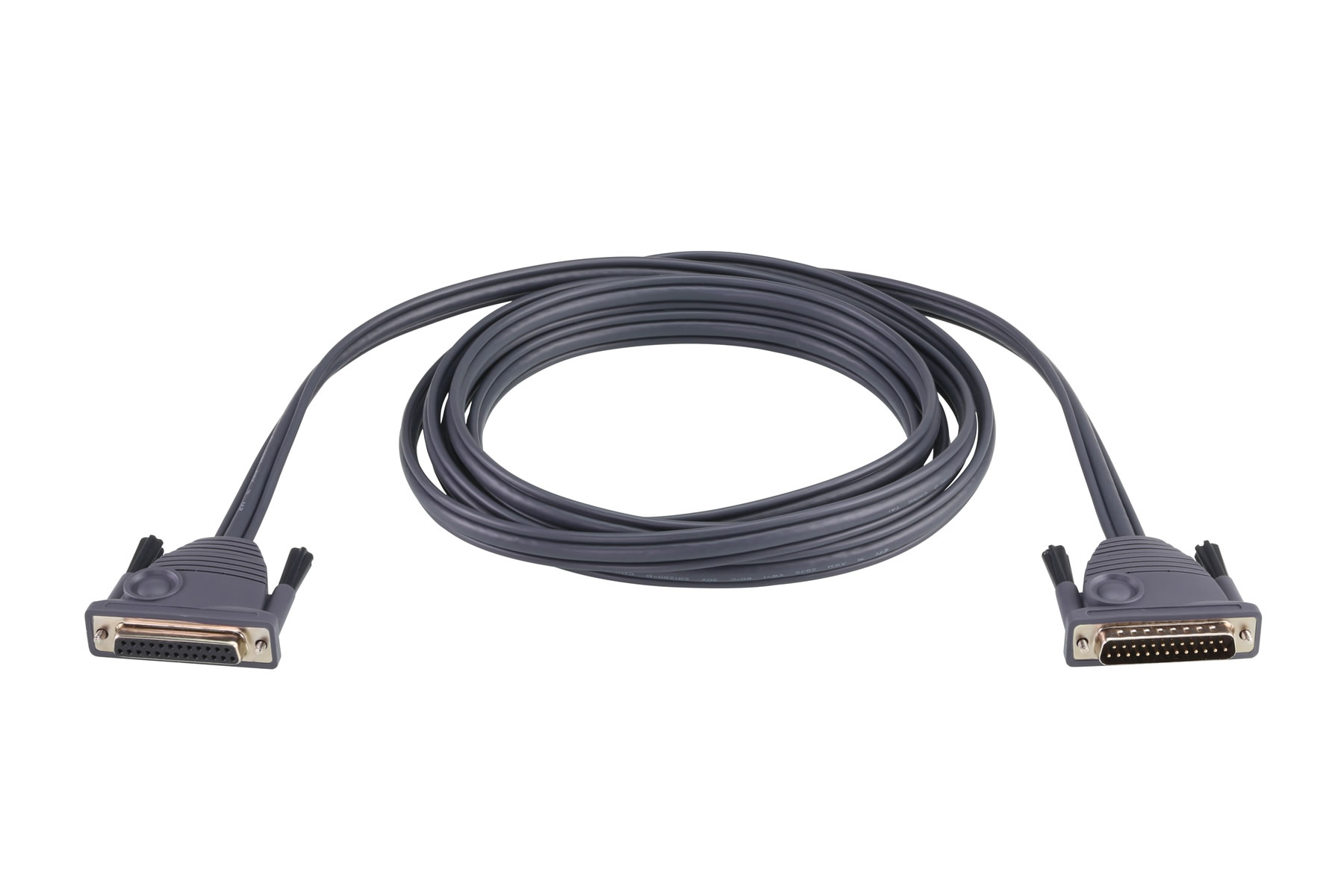
A typical RS-232 extender uses a single CAT5/6/7 cable to carry the serial signal between 300 and 1000 feet. The extender pair (transmitter at the control processor, receiver at the AV device) handles the timing and electrical conversion, with the control system communicating transparently through the extended link. Quality RS-232 extenders preserve the full bidirectional serial communication so the AV device's responses come back to the control processor for feedback and confirmation.
The same approach works for IR: an IR extender pair carries IR remote control signals over CAT cable between 300 and 1000 feet. The transmitter accepts IR from an IR receiver (or "IR eye") at the user-accessible location, carries the signal over CAT cable, and the receiver drives an IR emitter at the AV equipment. The user points their remote at the IR eye, the signal travels over CAT cable to the equipment rack, and the IR emitter blasts the signal back to the AV device's IR sensor at close range. This indirection lets users operate hidden equipment with normal remote controls.
For shorter residential applications, simple IR repeaters (active boxes that receive IR and re-emit it stronger or in a different direction) work without CAT cable extension. They handle 30 to 100 feet of IR routing within a single space, useful when the AV equipment is in the same room but hidden behind a cabinet or wall. For longer distances or for installations where the equipment is in a separate room or floor, CAT-based IR extenders are the right choice.
Some IR extenders support bi-directional IR, important when AV devices need to send confirmation or status back to the user position. Modern AV devices often respond to commands with IR-based confirmation; bi-directional IR carries these responses back along with the forward command path. For simple installations (the IR command is sent and the result is visible on the display itself), unidirectional IR works fine.
For larger installations with many controlled devices, RS-232 over IP gateways replace point-to-point RS-232 extension. The gateway connects to multiple RS-232 devices, exposes each as a network endpoint, and lets the control system send commands over the network rather than dedicated serial cabling. RS-232 over IP scales much better than point-to-point extension and integrates with modern network-based control architectures.
Many modern HDBaseT video extenders include RS-232 and IR alongside the video path, all in one CAT cable. This means a complete extension (video, audio, IR, RS-232, Ethernet, and PoE) goes over one CAT6 cable, which is far simpler than running separate extenders for each signal type. For installations where HDBaseT is the right choice for video, the included control signaling usually handles the IR and RS-232 needs too.
RS-232 and IR extenders are common in commercial AV installations where AV equipment is hidden in equipment racks: conference rooms (control system in a rack down the hall, equipment in the same rack, IR for user remote control), home theaters (equipment in a closet, IR eye in the viewing room), auditoriums and lecture halls (projector and source equipment at the front and back of the room respectively), hospitality (equipment headends with control extending to many rooms), and any installation where control system or remote control signals must travel beyond direct distance.
You need RS-232 extension whenever a control system needs to send commands to AV devices that are too far away for direct serial cable (typically over 50 feet). You need IR extension whenever a user's remote control needs to operate AV equipment that is hidden or far away (in an equipment rack in another room, behind a cabinet, in a closet). Common scenarios: conference rooms with equipment racks in a separate room, home theaters with equipment in a closet, auditoriums with projectors far from source equipment.
CAT-based RS-232 and IR extenders typically carry signals 300 to 1000 feet on standard CAT5e or CAT6 cable. For longer runs, fiber-based extenders cover kilometers. Wireless RS-232 and IR extenders also exist for installations where running cable is impractical, typically covering 100 to 200 feet of range. Always check the extender's specifications for the required distance: not all extenders support the full 1000-foot range.
Yes, many extenders combine multiple control signal types in one CAT cable: RS-232, IR (often bi-directional), Ethernet pass-through, and sometimes contact closure or relay control. This simplifies installation by carrying all the control signaling for a remote AV location over one CAT cable. Modern HDBaseT video extenders take this further: they carry video, audio, IR, RS-232, Ethernet, and PoE all on one CAT6 cable, providing complete extension in one product.
An IR repeater is a simple active device that receives IR signals at one location and re-emits them stronger or in a different direction, useful for routing IR around obstacles within a single room (30 to 100 feet of indirect IR routing). An IR extender goes much further: it carries IR signals over CAT cable, fiber, or wireless between rooms, floors, or buildings (300 to 1000+ feet). Use a repeater for in-room IR routing around cabinets and obstacles; use an extender for cross-room or cross-floor IR extension.
Use RS-232 over IP when you have multiple RS-232-controlled devices spread across an installation and want to integrate them with network-based control. The RS-232 over IP gateway connects to several RS-232 devices, exposes each as a network endpoint, and lets the control system send commands over the network rather than dedicated serial cabling. This scales much better than point-to-point extension and integrates with modern AV control architectures. For installations with one or two controlled devices, point-to-point RS-232 extension is simpler and cheaper.
Conference rooms (control system in a rack down the hall, AV equipment in the same rack or another rack, IR for user remote control to source equipment, RS-232 for the control system to send commands to displays and projectors), home theaters (equipment in a closet with IR eye in the viewing room, control system optionally with RS-232 to displays and projectors), auditoriums and lecture halls (projector at the front of the room and source equipment in the back, with IR and RS-232 extension between them), hospitality (equipment headends in central locations with IR and RS-232 control extending to many guest rooms), houses of worship (control booth with extended control to platform and overflow rooms), and any installation where the controlled equipment is far from where users or the control system operates.

On order over $300 and more for US and US territory

We Offer a 30-Day Money Back Guarantee

Full manufacturer's warranty and quality assurance

Safe checkout with trusted payment providers