




Start typing to see results...
Find the perfect solution
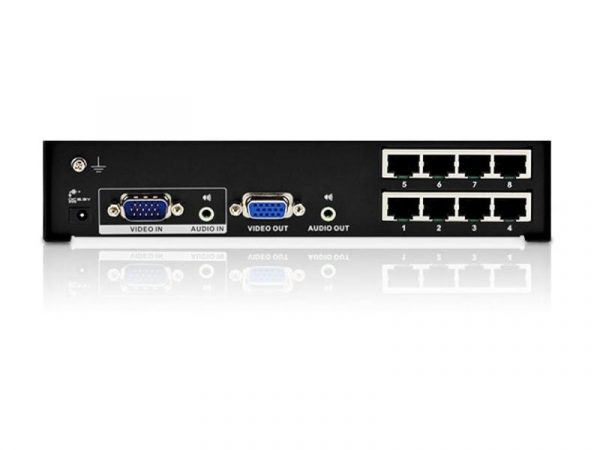
A VGA distribution amplifier routes analog computer-video signals from one source to multiple monitors, projectors, or large-format displays. Although VGA has been replaced by HDMI, DisplayPort, and DVI in most new installations, it remains common in schools, training facilities, classrooms, multimedia rooms, gaming arcades, and any environment where legacy projectors and computers are still in active service.
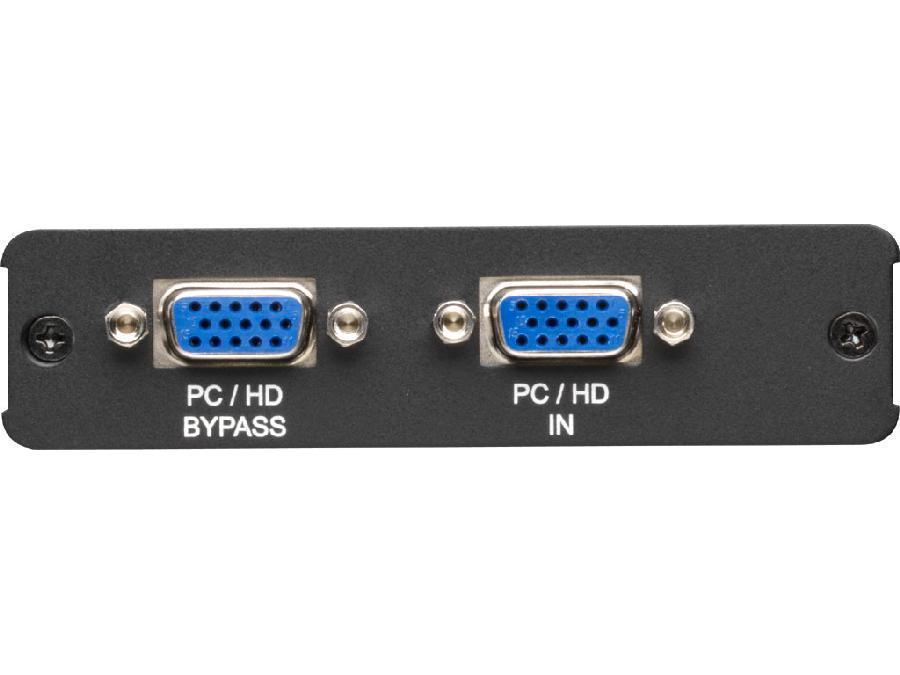
VGA uses a 15-pin D-Sub connector and carries analog RGB plus horizontal and vertical sync. Audio is not part of the VGA signal and is handled by a separate cable (usually 3.5 mm stereo) when needed. Modern VGA distribution amplifiers therefore typically include paired audio inputs and outputs, so video and audio travel through the splitter together and stay synchronized on the display side.
VGA distribution amplifiers support resolutions up to 2K (2048x1536) on quality cables and amplifiers at short distances, with 1920x1080 reliable in typical installations. As an analog signal, VGA quality degrades with cable length and electrical noise. Practical cable length per output is about 15 meters (50 feet) for 1080p; beyond that, ghosting, color shifts, and softness become visible. For longer runs, pair the distribution amplifier with VGA-over-CAT5 or VGA-over-fiber extenders.
VGA distribution amplifiers come in chassis sizes from compact 1x2 desktop units up to 1x32 rack-mount distribution chassis. Portable, rack-mount, and wall-mount form factors are all available. Active amplifiers can be cascaded for very large output counts. Built-in EDID management is common on modern units and helps when displays have different native resolutions.
VGA distribution amplifiers are particularly useful in education and training environments, where one teacher's or presenter's computer needs to drive a primary projector and several student monitors or repeat screens. Other common deployments include arcades and gaming installations, museum interactives running on legacy equipment, hospital displays not yet migrated to digital interfaces, and corporate boardrooms where infrastructure has not been upgraded.
Yes, primarily in schools, training rooms, and legacy environments with existing equipment. While VGA-only equipment is no longer manufactured at scale, vast numbers of existing projectors, classroom displays, and budget monitors still have VGA inputs. Schools and training centers in particular often run mixed environments where VGA must continue to work alongside newer interfaces. Hospitals, museums, government facilities, and corporate environments with long equipment-replacement cycles also keep VGA in service for many more years.
2048x1536 at 60 Hz on quality cables and amplifiers at short distances, with 1920x1080 reliable in typical installations. As an analog signal, VGA quality degrades with cable length and electrical noise, so the achievable resolution depends heavily on the install conditions. At short distances (under 5 meters) and with quality cable, 2K is achievable. In typical commercial installations with cable runs of 10 to 15 meters, 1920x1080 or 1600x1200 is the practical ceiling. Going above that often requires shorter cables, better cable quality, or upgrading to a digital interface.
Not over the VGA cable itself. The 15-pin VGA connector carries video only, with no provision for audio. Audio runs on a separate cable, usually 3.5 mm stereo or RCA. Most VGA distribution amplifiers therefore include separate audio inputs and matching audio outputs alongside each VGA video output, so video and audio travel together through the splitter and stay synchronized at the displays. When planning a VGA install, always remember to plan parallel audio cabling.
In practice, anything with more than two outputs is an active distribution amplifier. Passive splitting beyond 1x2 introduces unacceptable signal loss in analog video, with visible ghosting, color shifts, and softness on the displays. The terms "splitter" and "distribution amplifier" are often used interchangeably in product naming, but all commercial-grade multi-output VGA splitters today are powered, amplified devices. A passive Y-cable for VGA is occasionally seen at very short distances on test benches but is not appropriate for permanent installation.
The practical limit is around 15 meters (50 feet) for 1080p with quality cable. Beyond this distance, ghosting, color shifts, and image softness become visible, especially at higher resolutions. For longer runs, use a VGA extender that converts the signal for transport over CAT5/6 cable (typically up to about 300 meters or 1000 feet depending on resolution) or fiber optic for very long distances. A common architecture is one VGA distribution amplifier feeding multiple VGA extenders, with each extender placed near its target display.
Schools, universities, training centers, multimedia rooms, gaming installations, and legacy boardrooms are the most common environments. The most common single scenario is one teacher's or presenter's PC needing to drive a main projector plus several repeat displays or confidence monitors throughout a classroom or auditorium. Other use cases include arcades and gaming installations preserving the look of original equipment, museum interactives running on older systems, hospitals with legacy displays not yet migrated to digital, and corporate environments where the existing infrastructure has not been upgraded to HDMI.

On order over $300 and more for US and US territory

We Offer a 30-Day Money Back Guarantee

Full manufacturer's warranty and quality assurance

Safe checkout with trusted payment providers